If you’ve ever toured a modern capsule house, that sleek, compact, weather-resistant exterior probably made you think, “That’d be the perfect tiny, mobile home for my side of the mountain—what if something breaks or it doesn’t hold up when I need it?” As a capsule house supplier who’s spent the last 12 years designing, testing, and delivering units for mountain getaways, coastal retreats, and urban backyard rentals, I get that question every single week. For all the hype around their minimalist style and space-saving appeal, security is the number one concern for both first-time buyers and seasoned operators. A capsule house that’s not secured properly isn’t just a hassle—it can lead to stolen gear, weather damage, lost revenue, and even safety risks for whoever calls it home (temporarily or permanently). Capsule House

Today I’m breaking down the practical, field-tested security steps we walk every client through when they order a capsule house, no overly technical jargon, no fancy hacks that sound good but fail when a storm hits or someone tries to break in. These are the same strategies we use on our own demo units and the 700+ capsules we’ve delivered across North America over the last decade.
First, let’s talk about the foundation, because a capsule house is only as secure as what it’s sitting on. You can install the fanciest smart lock or an alarm system, but if the base it’s anchored to shifts, or a thief can yank the whole unit right off its spot, none of that matters. A common mistake first-time buyers make is setting their capsule on uneven, temporary skids or only using basic ground anchors designed for small sheds. For permanent placements—like a backyard guest space or a long-term rental—we always recommend a reinforced concrete slab with embedded anchor brackets. We work with local contractors to size these slabs based on your location: for rocky mountain sites, we add extra rebar to resist shifting during high winds or heavy snow; for coastal areas, we use corrosion-resistant steel brackets that don’t rust when exposed to salt air. For temporary or mobile placements—like a pop-up glamping site or a unit you move seasonally—we use heavy-duty, powder-coated steel frame anchors that clamp to the capsule’s undercarriage, not just the ground. These anchors are rated to hold 12,000 pounds, which is more than enough to resist strong winds and even prevent the capsule from being towed away by someone with a vehicle. We test these anchors every year in our on-site wind tunnel, and last winter, a test unit set up on our back lot withstood gusts over 90 mph without budging—no skids, no shifting, nothing. That’s non-negotiable.
Next, the exterior locks and access points, which are the first line of defense against intruders. Capsule houses have smaller surfaces than traditional homes, so every door, window, and utility access panel is critical. The flimsy snap-locks that come standard on many budget capsules? We replace those with ANSI/BHMA Grade 1 deadbolts, the highest residential security rating, on every exterior door. These deadbolts have a 1-inch throw, so they extend deep into the door frame, making it almost impossible to kick in. We also add secondary bolt locks to the windows—wait, I know, small windows, but that’s where intruders often try to get in because they’re less noticeable. Our windows are tempered glass, but we pair each with a slide bolt lock that secures the sash from the inside. For extra protection against window prying, we offer optional aluminum security bars that are subtle enough that they don’t ruin the capsule’s sleek look, but strong enough to resist crowbars. If your capsule has a utility access panel (for electrical, plumbing, or HVAC), we use tamper-resistant Torx screws instead of standard Phillips screws—standard screwdrivers can loosen Phillips screws in seconds, but Torx screws require a special key that’s harder for casual intruders to get. I still remember a client in Oregon who installed his capsule in a remote forest; a couple months after move-in, he told us a group of teens tried to pry open his utility panel, but the Torx screws held, and they left when they couldn’t get them off. That’s exactly what we want.
Smart security is the next layer, and it’s not just for urban units—we recommend it for every single capsule, regardless of where it’s placed. A lot of people think smart systems are expensive or complicated, but we work with three leading home security providers to offer pre-integrated packages that are tailored to capsule houses, not one-size-fits-all. The core of our recommended system is a wireless keypad door lock that syncs to a smartphone app, so you can lock and unlock the capsule remotely, generate temporary access codes for guests or maintenance workers, and get alerts if the lock is tampered with. We also add window and door sensors, and a motion sensor that’s tuned to ignore small animals like squirrels or raccoons—common pests in remote areas—while picking up human-sized movement. For outdoor areas around the capsule, we recommend a weatherproof smart camera that’s mounted 10 feet off the ground, so it’s high enough to avoid being tampered with, but low enough to capture clear footage of anyone approaching. These cameras sync to the same app, so you can check in on your capsule from anywhere, whether you’re at work, on vacation, or a few states away. We also partner with local monitoring services for clients who want 24/7 emergency alerts—if the alarm goes off, the monitoring service calls you first, then local law enforcement if you don’t respond. A client of ours in Texas uses this system for his three-unit glamping site; he can check all three capsules’ locks and cameras from his phone while he’s at his full-time job in Austin, and last year, a storm knocked out power for 12 hours, but his security system ran on the capsule’s backup battery and kept running the whole time. No missed alerts, no downtime.
Don’t forget about interior security, too—people often focus on keeping intruders out, but what about the stuff inside the capsule? If you’re using it as a home, a rental, or a storage space, you want to protect your belongings and the capsule’s fixtures. We install wall-mounted, fire-resistant safes that fit perfectly into the capsule’s interior design—they don’t stick out awkwardly, and they’re bolted to the floor so they can’t be carried off. For rental capsules, we recommend adding a lockable storage compartment for linens, tools, or other shared items, so guests can’t access personal belongings left by the owner. We also remind clients to use the capsule’s built-in HVAC system to maintain consistent interior temperatures, but that’s not just for comfort—extreme temperature changes can cause metal exterior panels to expand and contract, which can loosen locks or create gaps where moisture can get in, leading to rust or water damage. It’s a small step, but it ties directly to long-term security for the unit.
Another thing that’s easy to overlook is site planning, which is just as important as the locks or anchors. Where you place your capsule can make a huge difference in how secure it is. If you’re using a capsule as a backyard accessory, don’t tuck it behind a dense group of trees where it’s hidden from the street—place it within view of your home or a neighbor’s property, even if that means trimming a few branches. For remote sites like glamping retreats or mountain cabins, we recommend placing capsules within 50 feet of a main access road, adding solar-powered path lights along the approach, and keeping tall vegetation at least 10 feet away from the unit so intruders can’t hide. We also advise clients to register their capsule with local property records—this helps law enforcement identify a stolen unit faster, because capsules are unique, not like generic sheds. A client in Colorado had his capsule stolen from a remote construction site a few years back; because he had it registered, the police were able to track it within two days, whereas they might have taken weeks without that documentation.
Now, I know a lot of people out there are looking for “set-it-and-forget-it” security, but regular maintenance is key to keeping all these systems working. We provide every client with a 12-month maintenance checklist, and we offer annual on-site inspections for an extra fee, but even basic tasks can make a big difference. Every six months, test your deadbolts and locks to make sure they turn smoothly, tighten any loose exterior screws (the wind can shake things loose over time), and check the anchors to make sure they’re still securely attached to the undercarriage. For smart systems, update the app software regularly—provider releases patches that fix security vulnerabilities, just like your phone. I always tell clients: the best security is a routine, not one big purchase.
Before I wrap this up, I want to address a common myth I hear all the time: capsule houses are less secure than traditional homes because they’re smaller or more mobile. That’s simply not true. We test every capsule we sell to meet International Residential Code (IRC) standards for wind resistance, structural integrity, and security, so they’re built to be just as safe as a traditional home, if not more, because we cut corners on unnecessary space and add specialized features that fit their compact design. The key is tailoring the security to your specific use case and location, not copying what works for someone else’s capsule.
If you’re ready to purchase a capsule house and want to talk through security options that fit your needs—whether it’s a backyard guest space, a glamping retreat, a permanent tiny home, or something else—our team is here to help. We don’t do one-size-fits-all packages, so we’ll walk through your site, your budget, and what you need from your capsule, and build a security plan that works for you.
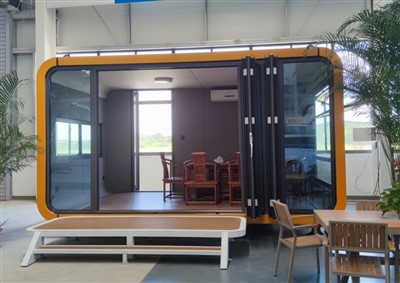
If you have questions, or you’re ready to start planning your capsule house, feel free to reach out to our team to discuss your specific needs.
Reducer References
- International Residential Code (IRC) for One- and Two-Family Dwellings, International Code Council, 2021.
- National Locksmith Association, “Residential Security Best Practices for Compact Dwellings,” 2022.
- Wind Load Test Standards for Recreational Structures, American Society of Civil Engineers (ASCE), 7-16.
- Coastal Building Security Guidelines, National Oceanic and Atmospheric Administration (NOAA), 2021.
- Mobile Tiny Home Safety and Security Report, Tiny Home Industry Association (THIA), 2023.
Shandong Dinglin Supply Chain Management Co., Ltd.
Shandong Dinglin Supply Chain Management Co., Ltd. is one of the leading capsule house manufacturers and suppliers in China, featured by quality products and low price. We warmly welcome you to buy advanced capsule house in stock here and get pricelist from our factory. For customized service, contact us now.
Address: No. 376, Huaguang Road, Fangzhen Town, Zhangdian District, Zibo City, Shandong Province
E-mail: sasha@sddinglin.com
WebSite: https://www.dinglingroup.com/
