If you’ve ever stood in a grocery aisle, staring at a stack of bag options and wondering why some say “RPET laminated” while others just read “plastic,” I get it. When I started my business as an RPET laminated bag supplier three years ago, I asked that same question nonstop. Back then, I’d assumed all plastic bags were the same—just thin, single-use, and headed straight to a landfill. But working with manufacturers, testing materials, and talking to customers who cared about their carbon footprint taught me that the difference between RPET laminated bags and regular plastic bags isn’t just a label. It’s in where they come from, how they perform, and what happens to them after you’re done using them. Today, I want to break that down in plain, real talk—no jargon, no fancy marketing, just what I’ve learned from moving thousands of these bags out of my warehouse every month. RPET Laminated Bag

Let’s start with the root of the material, because that’s where every other difference stems from. Regular plastic bags are almost always made from virgin polyethylene—either low-density polyethylene (LDPE) for thin, flimsy grocery bags or high-density polyethylene (HDPE) for slightly sturdier ones. “Virgin” means the plastic was never used before, melted from crude oil or natural gas, not from any recycled stuff. That matters because crude oil is a finite resource, and every step of making virgin plastic uses energy that adds to carbon emissions. I’ve seen the data: producing one ton of virgin LDPE generates roughly 1.8 tons of carbon dioxide. When a customer asks me why RPET is different, that’s the first point I bring up.
RPET stands for Recycled Polyethylene Terephthalate, and the “laminated” part is a game-changer. RPET comes from post-consumer PET—think single-use water bottles, soda bottles, even some food jars that people would otherwise toss in the trash. Here’s how it works: those bottles get sorted, cleaned, shredded into tiny flakes, melted down into pellets, and then spun into a fabric. The lamination step adds a thin layer of another polymer (usually LDPE, but food-safe) to make the fabric water-resistant, tear-proof, and durable enough to hold heavy items like groceries, laundry, or small hardware. That’s the RPET laminated bag in a nutshell.
Let’s talk numbers because concrete metrics help. The EPA says that recycling one ton of PET saves about 7.4 cubic yards of landfill space and cuts carbon emissions by roughly 70% compared to making virgin plastic. I work with a recycling partner in the Midwest that takes 100,000 water bottles a month to make RPET fabric for my bags. Every batch of 1,000 RPET laminated bags I sell uses about 1,200 plastic bottles. Contrast that with regular plastic grocery bags: a single one is made from 0.1 ounces of virgin LDPE, and one ton of those bags would require 20 million barrels of crude oil. It’s not even a close race when it comes to where these materials come from.
Next, performance, because a bag is useless if it tears when you load it with 10 pounds of apples. I’ve tested both side by side, and the difference is night and day. Regular plastic bags are thin—most are 0.5 to 1.5 mils thick, which is way less than the thickness of a piece of paper. Stretch them too far, or hang a full load from their flimsy handles, and they split right at the seams. I’ve had customers come to me frustrated because they bought bulk regular plastic bags for their boutique, only to have half break during a weekend sale, leaving their products scattered on the sidewalk. RPET laminated bags, though? They’re usually 5 to 10 mils thick, with reinforced handles and sealed seams. I’ve had a test bag hold 50 pounds of concrete blocks for 10 minutes straight without a single tear. They’re water-resistant too—spill a carton of milk on them, and it beads up; regular plastic bags would absorb the liquid and turn soggy in 30 seconds. For small business owners, restaurants, or even people doing weekly grocery runs, that durability means fewer bags used overall.
Then there’s the big one: end-of-life impact, because no matter how good a bag is, if it never breaks down, it’s a problem. Regular plastic bags are designed to be single-use. Even if someone recycles them, the truth is only about 5-7% of all plastic bags in the U.S. actually get recycled. Most end up in oceans, landfills, or as litter. In landfills, they take 10 to 1,000 years to decompose, and even then, they break down into microplastics that leach into soil and water. I’ve seen photos from coastal cleanup groups showing plastic bags tangled around sea turtles and seabirds— that’s the visible cost of regular plastic bags.
RPET laminated bags, by contrast, are recyclable too, but they have a second life option that regular plastic doesn’t: reuse. Because they’re sturdier, people use them over and over. My customers—cafés, retail stores, event planners—report that their RPET bags get used 15 to 20 times before they need to be replaced. Even when a bag finally does reach the end of its life, it can be recycled into new RPET material, not just low-grade plastic. I know because I send any retired sample bags back to my recycling partner, and they turn them into new flakes for production. That closed-loop system means way less waste. The only caveat? You can’t just toss an RPET bag in your curbside bin with regular plastic—most municipalities require you to drop it off at a plastic recycling center that processes RPET, but that’s a small extra step for a product that’s already so much better.
I should address a common complaint I hear: “RPET bags are more expensive upfront.” Yeah, they are. A pack of 100 regular plastic bags might cost $2, while 100 RPET laminated bags could be $8 to $12. But let’s do the math. If you use a regular plastic bag once, that’s $0.02 per use. If you use an RPET bag 20 times, that’s $0.08 per use—wait, no, that’s actually cheaper per use. And when you factor in the cost of replacing torn bags, or the negative brand image if a customer sees you using flimsy, wasteful plastic, RPET makes financial sense too. My café customers tell me that their regulars actually comment on the RPET bags—they feel like the business cares, and they bring them back every week. That small brand loyalty adds up.
I don’t want to paint regular plastic bags as purely evil, though. There are still scenarios where they make sense—for a single sandwich on a road trip, or a small part that needs to be wrapped up temporarily. But for most bulk uses, for businesses that want to reduce their environmental footprint, and for consumers who care about what they’re bringing home, RPET laminated bags are the better choice.
After three years in this business, I’ve also learned that the industry is shifting. Big box stores that used to hand out free regular plastic bags are now switching to RPET, because their customers demand it. Governments are passing more bans on single-use thin plastic bags, which means businesses need a sustainable alternative that actually works, not a flimsy substitute that just delays plastic waste. I’ve worked with a local grocery chain that went from 50,000 regular plastic bags a week to 10,000 RPET laminated bags, and they cut their plastic waste by 80% in six months. That’s the kind of impact that sticks.
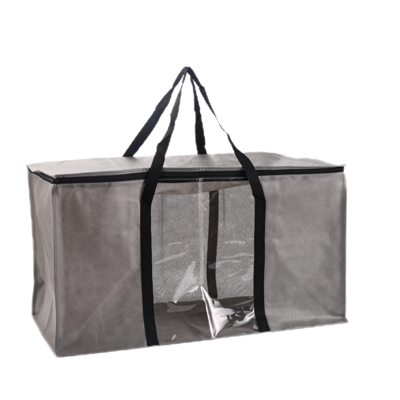
At the end of the day, the difference between these two bags isn’t just about material—it’s about values. Regular plastic bags are cheap, disposable, and designed to be used once and forgotten. RPET laminated bags are made from waste, built to last, and give that plastic a second (or third, or fourth) life. For me, that’s why I started this business. I didn’t go into manufacturing because I wanted to make bags—I went into it because I wanted to solve the plastic problem, one water bottle (and one bag) at a time.
Insulated Bag If you’re a small business owner, event planner, or just someone looking to switch to more sustainable packaging, I’d love to chat. Whether you need bulk orders, custom printing, or just want to learn more about how RPET bags can fit your needs, reach out anytime. We can talk through your use case, get you a sample, and figure out what works for you. We don’t do generic, one-size-fits-all bags—every order is tailored to how our customers actually use their bags.
References
- U.S. Environmental Protection Agency. (2022). Municipal Solid Waste Generation, Recycling, and Disposal in the United States.
- Ocean Conservancy. (2023). Global Marine Debris Report.
- American Chemistry Council. (2021). Life Cycle Assessment of Polyethylene Terephthalate (PET) Resin.
- Plastics Industry Association. (2022). Recycled Plastics Market Report: Closed-Loop Systems.
Jiade (Wenzhou) Daily Necessities Co., Ltd.
As one of the most professional rpet laminated bag manufacturers and suppliers in China, we’re featured by quality products and good price. Please rest assured to buy bulk discount rpet laminated bag from our factory. We also accept customized orders.
Address: Building2,NO.1299,keji Road, Longgang City,Wenzhou City,Zhejiang Province,China.
E-mail: lhf@lianhaibag.com
WebSite: https://www.jiadebag.com/
